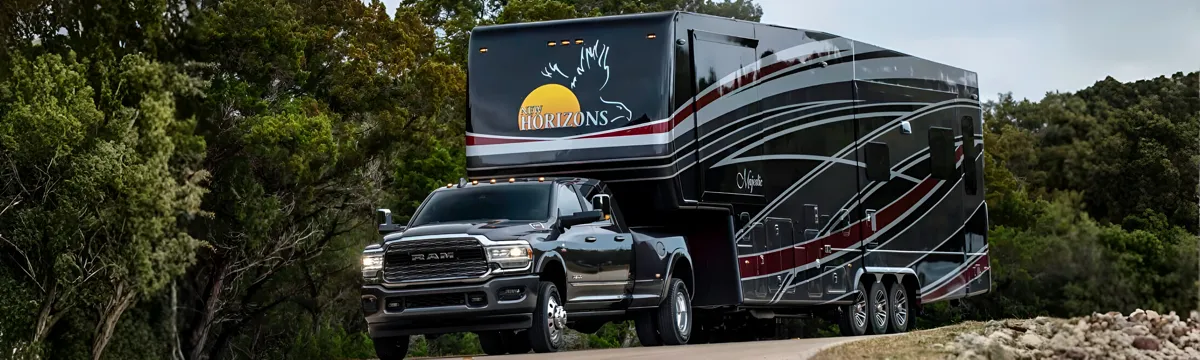
RV transport is a simple idea: your RV needs to be somewhere else and someone has to haul it there safely. Best Friend Transport does that job as a direct carrier, with our own trucks and drivers, one dispatcher from start to finish, and a price that does not change after you book. Here is how it actually works, what it takes and what to watch for.
How We Work: A Direct Carrier, Not a Middleman
Most companies you find when you search for RV transport do not own a truck. They take your order, post it on a load board and wait for some driver to accept it at a price that works for them. If nobody takes it, the price goes up or the date slips.
We work differently. Best Friend Transport LLC is a motor carrier registered with FMCSA (USDOT 4241168, MC 1642448). When you book with us, the RV moves on our equipment, driven by our drivers or by our affiliate, Jobe Kemba Transport LLC. Nobody else gets your load.
What that means for you in practice:
- The quote is the price. We quote what we will charge, and that is what you pay. No “market adjustment” two days before pickup because a driver wants more.
- One dispatcher, start to finish. The person who quotes your move is the one who schedules it and keeps you posted until delivery. You are not passed between a sales team, a broker and a driver you have never heard of.
- We know who is driving. We know the truck, the driver and the equipment before we commit to a date. That is how we can tell you honestly what is possible.
- 24/7, in English and Spanish. RV moves do not keep office hours, and neither do we.
Think of it as calling a friend in the business. You get a straight answer, a real number and someone who picks up the phone.
Types of RVs We Move
Every type of RV hooks up, loads and rides differently. Here is what we haul and what matters for each.
Fifth Wheels
Fifth wheels are the heaviest towables most owners have. They ride on a kingpin over the bed of the truck, so the tow vehicle needs a fifth-wheel hitch and enough capacity for the pin weight and total weight. Long units with several slide-outs, residential fridges and washer-dryer combos push those numbers up fast. Our dedicated page on fifth wheel transport covers the hitch, weight limits and how we prepare them in detail.
Travel Trailers
Travel trailers hook to a ball hitch and are the most common towable we see. They range from small single-axle campers to long triple-axle units. Most move by tow-away; very small, vintage or damaged trailers can go on a deck. If you are shipping one, read our guide to travel trailer transport for step-by-step prep.
Motorhomes: Class A, B and C
Motorhomes have their own engine, which changes the options:
- Class A units are bus-style coaches. They are long, tall and heavy, and some are close to or over the legal width once mirrors and awnings are counted.
- Class B camper vans are the smallest and fit on a deck trailer easily.
- Class C units have the cab-over bunk and sit on a truck chassis.
A running motorhome can often be driven to destination (drive-away) or carried on a deck. A non-running one needs a deck and sometimes a winch. Our motorhome options are [CONFIRMAR: métodos para motorhome — drive-away, deck, o ambos; límites de longitud y peso].
Toy Haulers
Toy haulers come as fifth wheels or travel trailers with a ramp door and a garage in the back. They tend to be heavier than a comparable RV because of the reinforced floor and the fuel station. Tell us whether the garage will be empty. Bikes, side-by-sides or golf carts inside change the weight and the tie-down plan, and may not be allowed at all: [CONFIRMAR: política para vehículos dentro del toy hauler].
Campers, Pop-Ups and Truck Campers
Pop-up campers, teardrops and other small trailers are light and simple to tow, but they still need a working coupler, tires and lights. Slide-in truck campers come off the pickup and have to ride on a deck, secured on their own jacks or a cradle: [CONFIRMAR: si transportamos truck campers sueltos].
Transport Methods: Tow-Away vs Deck/Flatbed vs Drive-Away
There are three ways to move an RV by road. The right one depends on the type of RV, its condition and its size, not on what is easiest for the carrier.
Tow-Away
Our truck hooks up to your trailer and tows it on its own wheels. This is how most fifth wheels, travel trailers and toy haulers move, because they were built to be towed.
Why we use it: it is the most efficient method for towables in good condition, and it does not add height, so tall units stay under bridge clearances. What it requires: tires in good shape and not too old, working brakes on every axle, working lights, a sound coupler or kingpin, and a breakaway switch that works. The truck is [CONFIRMAR: equipo — hotshot/gooseneck/dually; capacidad de arrastre].
Deck or Flatbed
The whole RV rides on our trailer. Its tires, brakes and axles do nothing for the entire trip.
Why we use it: for non-running motorhomes, damaged or vintage trailers, units with bad tires or brakes, small campers and camper vans. What to know: the unit sits higher, so height limits matter, and the cost is usually higher than tow-away. Our deck capacity is [CONFIRMAR: equipo de deck — longitud y peso máximo].
Drive-Away
A licensed driver drives your motorhome to destination under its own power. It only works for running motorhomes in good mechanical condition, and it puts miles on your engine, tires and generator hours. Whether we offer drive-away: [CONFIRMAR: ¿ofrecemos drive-away y con qué condiciones?].
Which One Is Right for Your RV?
| Your RV | Usual method | Why |
|---|---|---|
| Fifth wheel, good condition | Tow-away | Built to be towed; needs a fifth-wheel hitch |
| Travel trailer or toy hauler, good condition | Tow-away | Efficient, no added height |
| Trailer with bad tires, brakes or axles | Deck | Running gear does no work |
| Pop-up, teardrop or small camper | Tow-away or deck | Depends on condition and size |
| Running motorhome | Deck or drive-away | No miles on the engine with deck |
| Non-running motorhome | Deck with winch | Cannot drive or tow safely |
If you are not sure, tell us the RV and its condition. We will tell you which method makes sense and why.
What’s Included in Our RV Transport Service
When you book RV transport with us, the price covers:
- Dispatch and scheduling by one dispatcher, from quote to delivery.
- The truck, the driver and fuel for the entire route.
- A pickup inspection. The driver walks around the RV with you, notes existing scratches, dents, cracks and tire condition, and takes photos of every side, the roof line if visible, and the hitch area.
- Hookup or loading and securing. Safety chains, breakaway cable and lights checked on tow-away; straps and chains to proper tie-down points on a deck.
- Pre-trip and en-route checks. Drivers recheck tire pressure, hub temperature, lights and hitch at stops.
- Tolls, permits and route planning for a legal-size unit. If your RV is over the legal width of 8.5 feet (102 inches), oversize permits are needed and we include them in the quote once we know the real dimensions.
- Updates from your dispatcher during the trip: [CONFIRMAR: cómo se envían las actualizaciones — llamada, texto, WhatsApp, seguimiento GPS].
- A delivery inspection against the pickup photos, with your signature at the end.
What is not included: repairs to the RV, setting it up at a campsite, leveling, hookups to water and power, or winterizing. Payment terms are [CONFIRMAR: depósito, forma y momento del pago].
How Much Does RV Transport Cost?
The price of moving an RV comes down to a handful of factors:
- Distance. The biggest one. Longer moves cost more in total but usually less per mile.
- Type and size. A 42-foot fifth wheel needs more truck than a 20-foot travel trailer.
- Method. Deck usually costs more than tow-away.
- Route. Busy corridors between big metro areas are easier to schedule than remote pickups.
- Season. Snowbird season and the end of hurricane season keep trucks busy on some lanes.
- Condition. A unit that does not run, or needs a winch, takes more time and equipment.
- Timing. A flexible pickup window costs less than “it has to be tomorrow”.
- Oversize. Anything wider than 8.5 feet needs state permits and sometimes an escort.
Our full RV transport cost guide explains each factor and what moves the price per mile. On real moves we hauled between February 2025 and October 2026, travel trailers and fifth wheels going 700 miles or more ran about $1.70–$2.10 per mile, and runs under 300 miles were usually $400–$600 in total. That is not a quote: the exact price depends on your specific move. The only number that matters is the one for your RV and your route, and we give you that one in writing.
One thing we will not do: quote low to win the job and then raise it when nobody wants to haul it at that price. That is how the broker model often works, and it is the reason we decided to be a carrier.
Insurance and FMCSA Registration
Before you hand your RV to anyone, check two things.
Registration. Any company hauling RVs across state lines for hire needs a USDOT number, and a for-hire carrier needs operating authority (an MC number). Ours are USDOT 4241168 and MC 1642448, registered to Best Friend Transport LLC. You can look them up yourself on the FMCSA SAFER website. Make sure the authority type says “carrier”, not only “broker”.
Insurance. FMCSA requires registered carriers to carry liability insurance. Cargo coverage, which protects the RV itself while it is in our care, is separate. Ours is [CONFIRMAR: monto del seguro de carga y aseguradora]. We send you the certificate of insurance on request before pickup.
A few honest points about insurance:
- Document the condition. The pickup inspection and photos are what any claim is measured against. Take your own photos too.
- Keep your RV policy active. Call your agent. Some policies cover the unit while it is being transported; some do not.
- Personal items usually are not covered. Cargo insurance covers the RV, not what is inside it.
- Pre-existing problems stay pre-existing. A soft spot in the roof or a weak tire will not be covered because it failed on the road.
Transit Times and Scheduling
How fast we can move your RV depends on three things: when we can pick it up, how far it goes and what happens on the road.
Pickup. We schedule a pickup window, not a promise to the minute. Our usual lead time is [CONFIRMAR: días de anticipación habituales para recoger]. Urgent moves are possible when we have a truck nearby: [CONFIRMAR: política de servicio urgente].
Transit. Our drivers follow federal hours-of-service rules, which limit how many hours they can drive per day. Add fuel stops, inspections, weather and traffic, and a cross-country trip takes several days. Our typical times are [CONFIRMAR: tiempos de tránsito propios por distancia].
Delivery. Your dispatcher confirms the delivery window ahead of time so you or your contact can be there.
We do not guarantee exact delivery dates. Wind, snow, road closures and mechanical issues happen, and a carrier that promises otherwise is guessing. What we do guarantee is that you will know where things stand.
How to Prepare Your RV for Transport: Checklist
A good move starts before the truck arrives. Use this checklist the week before pickup.
Outside
- Retract all slide-outs and lock them.
- Close and lock the main awning and every window awning; add straps if the arms are loose.
- Lower and secure TV antennas, satellite dishes and any roof accessories.
- Close every roof vent and cover.
- Remove or secure bike racks, ladders, spare tires and anything bolted to the rear.
- Raise and lock all stabilizer jacks and the tongue or landing jacks.
- Check tire pressure and look for cracks, bulges and tire date codes (towables).
- Confirm brakes, lights and the breakaway switch work (towables).
Inside
- Secure or remove loose items. Check cabinets, the fridge, the shower and under the bed.
- Latch cabinet and drawer doors; use tape or child locks on the ones that pop open.
- Empty the black and gray tanks; drain fresh water to cut weight.
- Turn off propane at the tank and close the valves.
- Turn off the water heater and the fridge.
- Disconnect or switch off the batteries if your RV has a disconnect.
Paperwork and Keys
- Registration and proof of ownership or the dealer’s bill of sale.
- A complete set of keys for every door, compartment and the hitch lock.
- Your own dated photos of every side and the roof, if you can safely get them.
- Names and phone numbers of the person at pickup and the person at delivery.
Tell us before pickup if anything is wrong: a leak, a slide that sticks, a flat, a brake that drags. It changes the plan, and it is much easier to solve on the phone than at the curb.
Interstate Moves and Out-of-State Dealer Purchases
A large share of RV transport happens because someone bought an RV far from home. The right unit at the right price is often two or three states away, and the dealer’s delivery fee may be higher than an independent carrier.
Here is how a dealer pickup works with us:
- You send the details. Dealer name, address, contact, stock number or VIN, and when the unit will be ready.
- We coordinate with the dealer. Your dispatcher confirms the release date, hours and the paperwork the dealer gives the driver.
- The dealer does the walk-through. At pickup, the driver inspects and photographs the RV with the dealer’s staff. If something is wrong at the lot, it is documented before the RV leaves.
- We deliver to you. Home, storage, a campground or your own dealer for service.
A few things to settle with the dealer before pickup: that the pre-delivery inspection (PDI) is done, that the unit has a temporary tag or transport plate as your state requires, and that the propane tanks and batteries are installed or shipped separately as agreed.
Moving between two of your own addresses works the same way. Snowbirds, full-timers, families relocating for work and owners sending a unit to a repair shop out of state all use the same process. We also haul for dealers and RV manufacturers; if you need trucks for your own trailers, see our Power Only trucking service.
RV Transport Seasons: Snowbirds and Hurricanes
RV transport has a calendar, and knowing it helps you plan.
Snowbird season. Every fall, a wave of RVs heads south to Florida, Texas, Arizona and southern California. In spring, they go back north. Those weeks fill up first on the busiest lanes. If you are a snowbird, book early and tell us your flexible dates. A wider window is easier to fit and often cheaper. In our own records from February 2025 to October 2026, RV moves peaked in February and March and were slowest in July.
Hurricane season. From June through November, Gulf and Atlantic coast owners may need to move an RV out of a storm’s path, or back in after it passes. Evacuation moves depend on road conditions and what authorities allow. If you live in a hurricane zone, have your RV ready to roll before the season: tires checked, slides working, paperwork in one place, and our numbers saved. Call early. Once evacuation orders go out, roads and trucks fill up fast.
Winter in the north. Snow and ice slow everything down and can close mountain passes. A carrier that pushes through a storm to hit a date is taking a risk with your RV. We would rather call you and wait.
Carrier vs Broker: Why It Matters for Your RV
This is the most important thing to understand before you book.
A broker sells you transport but does not provide it. They take your order and post it on a load board, where independent drivers bid on it. A carrier owns the trucks and employs or contracts the drivers who actually haul your RV.
| Broker | Direct carrier (us) | |
|---|---|---|
| Who hauls your RV | A driver found after you book | Our own driver or affiliate |
| Price | An estimate that can change if no one takes the load | The quote is the price |
| Pickup date | Depends on when a driver accepts | Set when you book, with a window |
| Point of contact | Broker, then a driver you don’t know | One dispatcher from start to finish |
| Insurance | The unknown carrier’s policy | Ours, with a certificate you can see first |
| Registration | Broker authority | Carrier authority (USDOT 4241168, MC 1642448) |
Brokers are legal and some do good work. The problem is the incentive. A low first quote wins the order, and the real price shows up when no driver accepts it. Then you hear about a “market adjustment”, a missed pickup or a driver you have never spoken to.
How to tell who you are talking to: ask “Will your own truck and driver haul my RV?” and look up the MC number on FMCSA SAFER. A carrier answers yes and shows carrier authority.
How to Get an RV Transport Quote
Getting an RV transport quote from us takes a few minutes. Have this ready:
- Pickup and delivery addresses or ZIP codes, and whether it is a home, dealer, storage lot or campground.
- The RV: type, year, make, model and length. Width and height if you know them.
- Condition: does it run (motorhomes), are the tires and brakes good (towables), any damage.
- Dates: when it is ready and when you need it there. Flexible dates help.
- Contacts at pickup and delivery.
Ask for your free RV transport quote online, call sales at (239) 763-5447, or message us on WhatsApp at (954) 899-9436. Your dispatcher will confirm the details, give you a firm price and hold your pickup window once you approve. If you want to know more about who we are first, read about Best Friend Transport.
Updated: