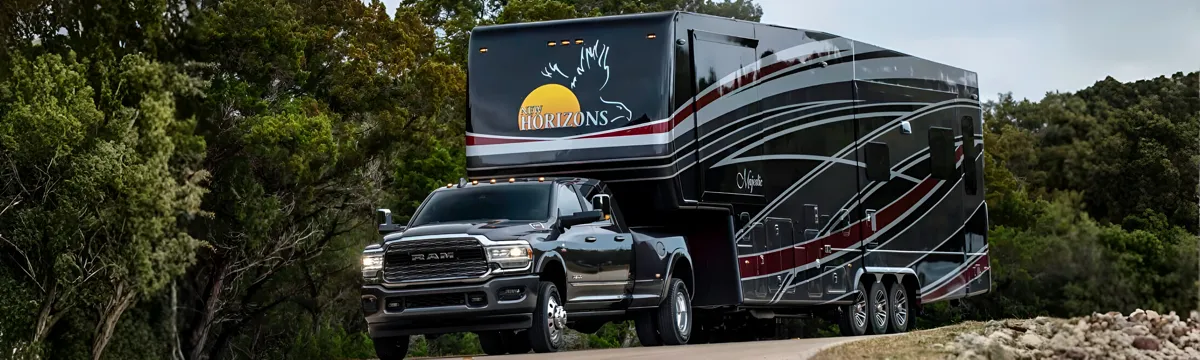
Fifth wheel transport is not the same job as towing a bumper-pull camper. The hitch, the truck, and the weight are all different, and getting any of them wrong is how trailers get damaged. Here is how we move fifth wheels as a direct carrier, what we check, and what you should do before pickup.
What Fifth Wheel Transport Is and Why It Needs Specific Equipment
A fifth wheel is a towable RV that connects inside the bed of a pickup instead of at the rear bumper. That design gives you more living space and a more stable tow, but it also means not every truck can move it. Fifth wheel hauling starts with the right equipment, not just a driver with a pickup.
The kingpin and the fifth-wheel hitch
The front of your fifth wheel has an overhang with a steel kingpin pointing down. That kingpin locks into the jaws of a fifth-wheel hitch bolted into the truck bed, over or just ahead of the rear axle. Because the connection sits over the axle, a large share of the trailer’s weight presses straight down on the truck. That number is the pin weight, and it is usually much higher than the tongue weight of a travel trailer the same size.
Some owners use a gooseneck adapter on their kingpin. If yours has one, tell us when you ask for a quote so the driver shows up with the matching setup.
The truck has to be rated for the load
Being able to pull a trailer is not the same as being rated for it. The truck needs enough payload for the pin weight, enough towing capacity for the gross weight, and brakes that can stop the combination on a downhill grade. Large fifth wheels often call for a dual-rear-wheel truck. Our equipment for this work is [CONFIRMAR: equipo — dually/hotshot con enganche de quinta rueda, capacidad de remolque], matched to your trailer before the move is booked.
Height matters too. Fifth wheels are tall, and the overhang sits above the truck bed. Most states cap vehicle height around 13 ft 6 in, so the driver plans the route around low bridges and overpasses.
How We Move Your Fifth Wheel, Step by Step
This is what fifth wheel transport looks like from our side of the truck:
- Quote and details. You send pickup and delivery locations, year, make, model, length, and any known issues. We confirm the equipment fits and give you a firm price. The quote is the price.
- Scheduling. One dispatcher handles your move from booking to delivery. You get a pickup window and a direct line, in English or Spanish.
- Walk-around at pickup. The driver inspects and photographs the exterior, roof edge, tires, and hitch area, and notes existing scratches or dents with you.
- Mechanical check. Tire pressure and tread, wheel lug nuts, running lights, brake lights, turn signals, and the trailer brakes through the 7-pin connection. A fifth wheel rides on its own axles the whole trip, so this check matters.
- Hookup. The driver sets the hitch height, locks the kingpin, confirms the jaws are closed, connects the breakaway cable and the 7-pin plug, raises the landing gear fully, and does a tug test before rolling.
- On the road. Slides in, steps up, vents closed. The driver stops to check tires, hubs, and the hitch on a regular schedule.
- Delivery. A second walk-around with photos, you sign off, and the driver unhooks and sets the landing gear where you want it.
Length, Weight, and What Changes the Move
Fifth wheels range from compact units in the mid-20-foot range to large toy haulers and residential models over 40 feet. Size changes three things:
| Factor | Smaller fifth wheel | Larger fifth wheel |
|---|---|---|
| Truck needed | Heavy-duty pickup can work | Usually a dually or medium-duty truck |
| Route planning | Fewer restrictions | Height, length, and turning space matter more |
| Pickup and delivery access | Most driveways and lots | Tight gates, trees, and steep driveways need checking |
Combined truck-and-trailer length limits vary by state, so long rigs need a route check before we confirm. Width is rarely the issue: most fifth wheels stay within the standard 8.5 ft (102 in) legal width with slides in. If yours has an add-on that sticks out, tell us.
Send us the GVWR from the sticker on the trailer, not just the dry weight. A full fifth wheel can weigh thousands of pounds more than the brochure says.
Personal Items Inside Your Fifth Wheel
This is the question we get most. Your fifth wheel is a home, and it is tempting to use it as a moving box. A few honest points:
- Every pound inside adds to the load on the truck, the hitch, and your trailer’s tires.
- Loose items shift on the road. Cabinets pop open, and heavy boxes slide into walls and slide-out mechanisms.
- Cargo insurance on a trailer often treats personal belongings differently from the trailer itself.
Our current policy is [CONFIRMAR: política de artículos personales — límite de peso y si el seguro de carga los cubre]. As a rule, remove valuables, documents, firearms, and anything heavy. Tape or latch cabinets and the fridge, and pack the rest low and tight.
How to Prepare Your Fifth Wheel for Transport
A good prep saves time at pickup and prevents most damage claims:
- Empty the tanks. Fresh, gray, and black water add weight and slosh.
- Secure the inside. Latch doors and drawers, close roof vents, lock the fridge, take down TVs that are not hard-mounted.
- Retract everything. Slides, awnings, steps, and stabilizer jacks. Make sure the landing gear goes all the way up.
- Check the tires. Correct pressure, no cracks or bulges. Old tires on a fifth wheel that sat for years are the most common roadside problem we see.
- Propane off. Close the tank valves.
- Clear the pin area. The driver needs room to back the truck under the kingpin.
- Keys and paperwork. Leave the entry key and a copy of the registration with the trailer.
For a longer checklist covering every towable and motorhome, see our RV transport services guide.
What Fifth Wheel Transport Costs
Price comes down to distance, size and weight, pickup and delivery access, timing, and season. Heavier fifth wheels need heavier trucks and more fuel, and routes that avoid low clearances can add miles. On real fifth wheel moves we hauled between February 2025 and October 2026, the median was $2.10 per mile and $1,200 per move, for a median trip of about 600 miles; runs of 700 miles or more came in around $1.80–$2.00 per mile. That is not a quote: the exact price depends on your specific move. For the full breakdown by RV type and distance, read our RV transport cost guide.
Moving a bumper-pull camper instead? Tow-away vs flatbed works differently there, so see our page on travel trailer transport.
Why Ship a Fifth Wheel with a Direct Carrier
Most companies that show up when you search for 5th wheel transport do not own trucks. They post your load, and whoever accepts the lowest rate hauls it. That is how pickup dates slip and prices change after you book.
Best Friend Transport is the carrier. Our trucks and drivers, or those of our affiliate Jobe Kemba Transport LLC, do the hauling. We never resell your load. One dispatcher follows the move from quote to delivery, 24/7, in English and Spanish. You can check our registration on FMCSA SAFER under USDOT 4241168 and MC 1642448, and read more about Best Friend Transport.
Ready to move it? Get a free fifth wheel transport quote or call sales at (239) 763-5447. On WhatsApp, we are at (954) 899-9436.
Updated: